

A New Vision for a New Century: Cittaslow Presents Its 21st Century Manifesto

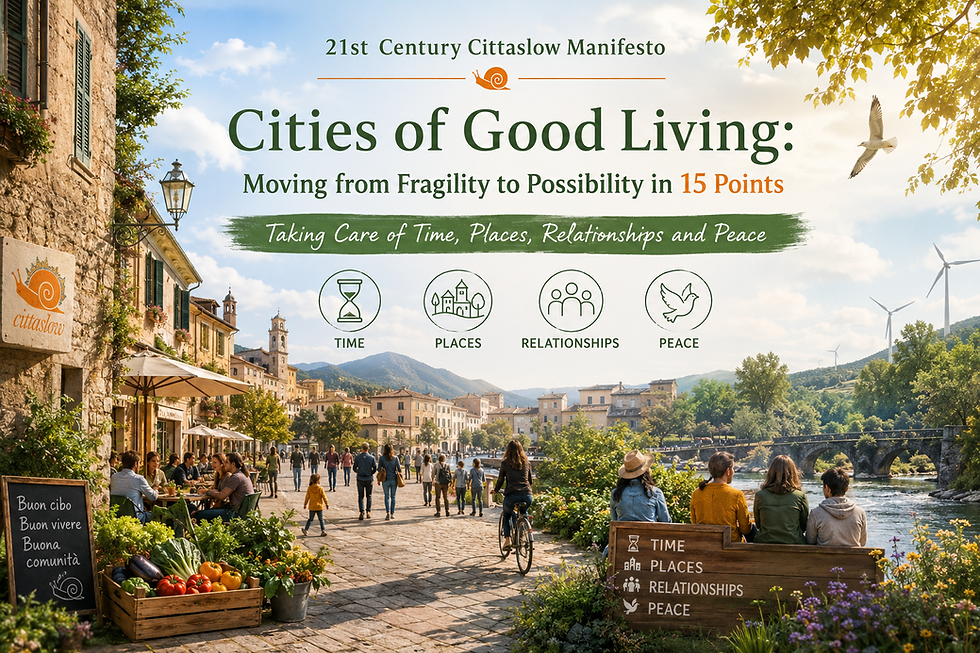
Cittaslow International has unveiled the 21st Century Cittaslow Manifesto, a new charter that reaffirms and renews the founding vision of the network for a world facing unprecedented environmental, social and technological change. Titled Limits Seen as Principles for the Future, the Manifesto sets out how the philosophy of "Cities of Good Living" translates into concrete governance for the decades ahead.
The Limit as a Principle, Not a Constraint
At the heart of the new Manifesto is a single, powerful idea: the limit. Far from being a restriction, Cittaslow argues that recognising limits is what makes freedom, sustainability and democracy possible in the first place. A city that understands its limits — in water, energy, soil, food, landscape, time and trust — is a city that protects its own future rather than consuming it.
This principle now runs through every area of municipal governance the network promotes: energy planning, water management, waste reduction, mobility, food supply chains and landscape protection. As the Manifesto puts it, "a city that consumes everything it possesses also consumes its own future."
Three Keywords: Limit, Local, Community
The Manifesto is built around three keywords that have always defined the Cittaslow movement, now reframed for the 21st century:
Limit — the ability to distinguish growth from destruction, and innovation from blind consumption.
Local — valuing local knowledge and craftsmanship while embracing innovation through the principle of "innovation by tradition," and reviving small towns and metropolitan neighbourhoods where everyday life happens on foot, by bike or by public transport.
Community — residents as active participants rather than passive users of services, whose engagement builds resilience, trust and democratic quality.
Fifteen Points for a Human-Scale Future
Beyond the keywords, the Manifesto sets out 15 points that translate this philosophy into a working agenda for Cittaslow towns worldwide. They range from the practical to the visionary: treating the city as a woven fabric of relationships rather than a mere surface of buildings; using digital tools and artificial intelligence responsibly, so that technology serves life rather than replacing it; embracing "reflective modernity" and the right pace of time for living, working and caring; and building a human-scale alternative to accelerated urban development.
Other points address landscape conservation and the circular economy, short supply chains "from farm to table," civic friendship as the basis for peaceful coexistence between differences, and Cittaslow Education as a lifelong dialogue between generations. The Manifesto closes with a point on certification itself, describing the network's assessment criteria — aligned with 14 of the UN Sustainable Development Goals — as a form of civic infrastructure that makes good living measurable and transferable.
Why It Matters Now
The original Cittaslow Charter, launched in 1999, was a response to the homogenising pressures of globalisation. Twenty-five years on, the challenges have multiplied: climate change, digital acceleration, the metropolisation of the world's population and growing pressure on natural resources. The 21st Century Manifesto does not abandon the founding spirit of the movement — it sharpens it, giving mayors and citizens a clearer set of principles to guide decisions in a far more complex world.
As the Manifesto states, the goal is to move "from fragility to possibility," placing the care of time, places, relationships and peace at the centre of how Cittaslow towns are governed and lived in.


Readers can use this blog knowledge base to explore the subject at their own pace. The article is divided into manageable sections. I especially appreciated the discussion of common problems. The author also provided realistic solutions. The conclusion highlighted the most useful points. Thank you for sharing such detailed material.
The expert content in this article helped clarify several difficult aspects of the subject. The author explained the connections between different factors in a logical way. I appreciated the careful analysis and absence of exaggerated claims. The practical examples made the information easier to relate to. The final observations provided useful direction. Thank you for sharing your expertise.
Reading through this, I noticed a level of polish that suggests real effort went into revisions. Nothing felt like a rough first draft, with each sentence clearly considered carefully beforehand. That attention to detail is something I hope continues across the latest updates going forward. It made for a genuinely smooth and satisfying reading experience overall. Nicely polished piece, thanks for this one.